

The Challenge in Jesus
Consider the following famous Christian quotes:
“Going to church doesn’t make you a Christian any more than going to a garage makes you an automobile.” – Billy Sunday
“Be careful how you live. You may be the only Bible some person ever reads.”
– William J. Toms
Have you ever encountered quotes like these and nodded your head in agreement? Then you might have more in common with the Pharisees than you think!
Now hold on there, dear reader! Don’t “x” out on me just yet! I know that referring to most of this reading audience as, essentially, “a bunch of Pharisees” is a risky strategy. But I read an article this week, written by O. Wesley Allen Jr. for the website workingpreacher.org, that really challenges our understanding of these religious leaders who so often found themselves at odds with Jesus throughout the Gospels. Professor Allen helps us understand that the Pharisees might not be so different from you and me after all. He writes:
“(One could say that) Pharisees were the liberal, mainline Protestants of first century Judaism. While other Jewish sects claimed the people needed the priesthood and the temple to mediate between them and God, the Pharisees democratized religious experience.
Often described by Christian preachers as jot and tittles of rules and regulations of religious observance, the Pharisees offered to people modes and means of devotional practice that could be followed anywhere by anyone without direct oversight or mediation by religious leaders (clergy). This means that we can assume the challenges which the Gospel writers present them as having to Jesus’ actions are sincere concerns about the welfare of the people and the shared ritual practices available to them.”
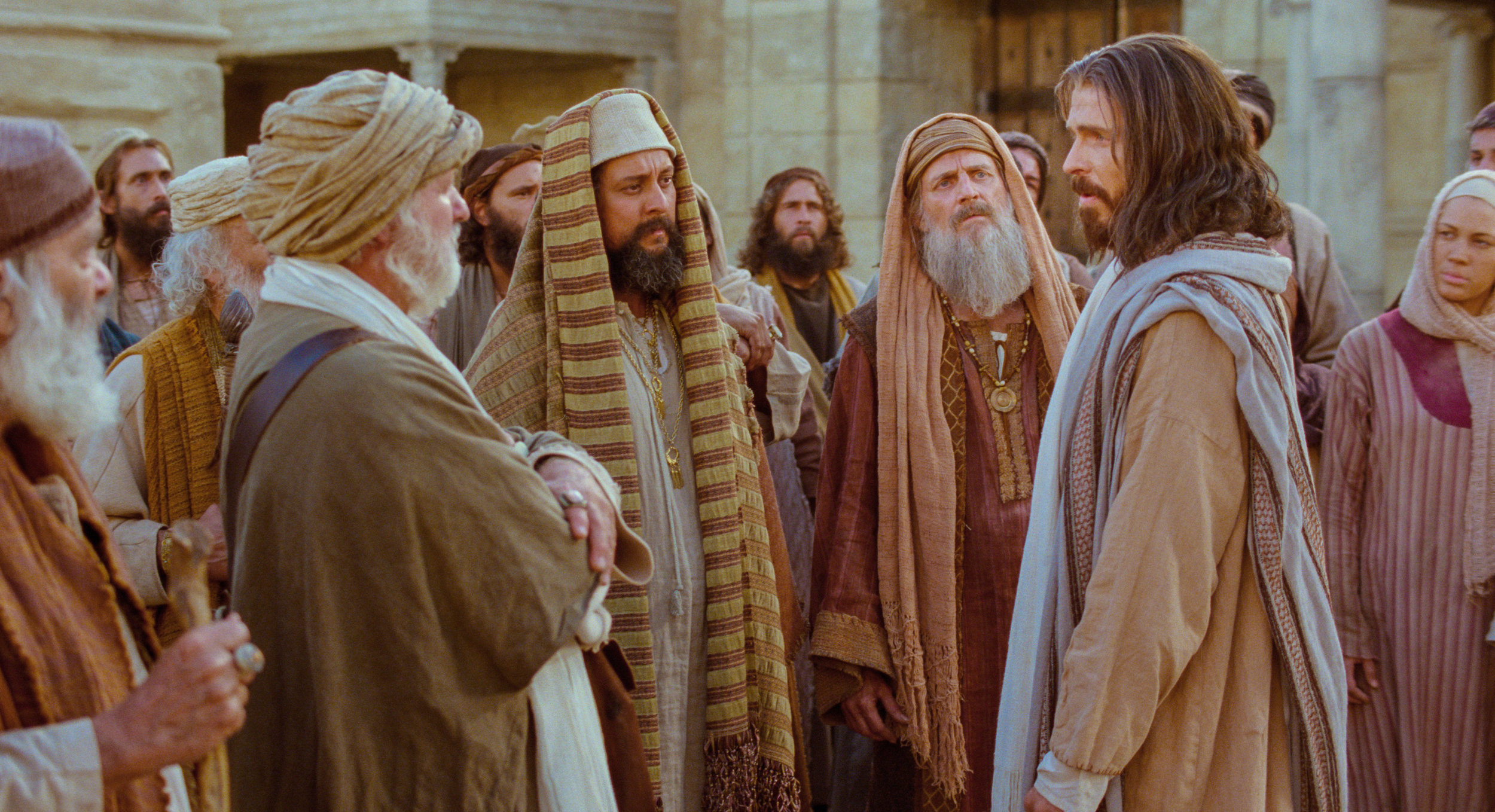
In this Sunday’s gospel passage (Luke 6:1-11), we will observe Jesus clashing with the Pharisees once again, this time over the observance of the Sabbath. Set aside as a holy day of rest, the Pharisees were deeply concerned with what was permitted on this day, in the interest of living righteously and staying closely connected to God. First, they engage in a minor tussle with him over the activity of plucking grain with his hungry disciples. His parting words to them must have sent a chill up their collective spine: “The Son of Man is lord of the Sabbath.” Surely, they thought, he could not be referring to himself? Consider how this claim of ultimate authority clashes with Pharisees’ noble, even Reformation-like idea of a “democratized religious experience.”
On another sabbath, Jesus was teaching in the temple in the presence of the Pharisees, and in the midst of the congregation there was a man with a withered hand. They watched him to see whether he would cure him…ready to make an accusation against him if the situation escalated. Jesus asks them: “Is it lawful to do good or to do harm on the Sabbath, to save life or to destroy it?” And with the simple act of Jesus speaking to him (speaking, of course, was not forbidden on the sabbath), the man’s hand was miraculously restored.
Why were the Pharisees so full of fury after this encounter? Perhaps fury is experienced when a religious system, like the one the Pharisees had so carefully and thoughtfully crafted, begins crumbling down. A “democratized religious experience” like the one they knew faces an insurmountable challenge in Jesus Christ. This radical preacher, whose teaching and healing powers are unmatched, is a very real threat to their life of faith. He claims for himself the authority to forgive sins, sees himself as “above the law” in encounters such as these, and continually surrounds himself with sinners whose disregard for the law is brazen and alarming.
Does the Son of God still threaten our carefully crafted religious beliefs today, with his claims to authority, and his insistence that we live by his forgiveness and grace instead of our merits and accomplishments? What does life look like when we give up the struggle of trying to live by our own righteousness and rest in his graceful lordship instead? These are the questions I am considering as I prepare the sermon for this coming weekend. But I think that life lived in him looks something like this: a blessed rest in the peace of faith, a restoration to abundant life….a sabbath beyond compare.
Pastor Katherine
(Photo courtesy of www.lds.org)
An Offer We Can't Refuse
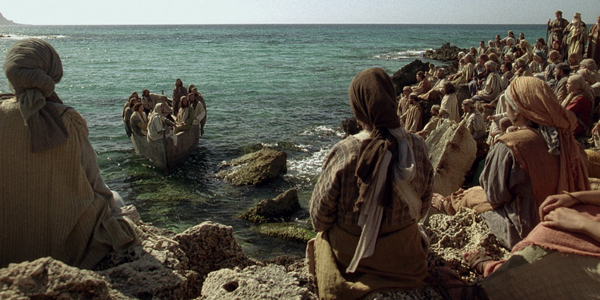
Sometimes remarkable things come to light in the most unlikely of circumstances. Simon provides his fishing boat for Jesus to sit in as he teaches the crowd gathered at the shore. Afterward Jesus directs him to deeper water to fish. As a professional fisherman, Simon obeys only out of respect for Jesus, pointing out their complete futility the night before. But when Simon’s net begins to break from the sheer weight of the fish, and he must signal his partners to help with the haul before his boat sinks, he recognizes more than a miracle. Overwhelmed, it is not the enormous catch itself that brings Simon to his knees, but the One in whose Presence he suddenly recognizes. Fearful awe and the awareness of personal sin are human reactions to the Holy breaking through in glory. Often a call to obedience follows, this one – to fish for people – one of the most consequential invitations in human history. Everything will change for Simon in his leaving the boats to follow Jesus! Is the invitation of Jesus not an offer we can’t refuse?
Growing Pains: A Reflection on the weekend’s Scripture Texts
Growing Pains: A Reflection on the weekend’s Scripture Texts
Jeremiah 1:4-10; Luke 4:21-30
Our Scripture texts for today remind us of a well-beloved Sunday School song from days of yore. Recall the song with me:

“It’s about love, love, love (re-Pete)
Cuz God loves us we love each other:
Father, Mother, Sister, Brother.
Everybody sing and shout!
Cuz that’s what it’s all about.”
This “all about” word, that’s at the very heart of God (I John 4:7-12) calling the young prophet, Jeremiah out of his comfort zone to proclaim God’s Word “to all the nations” (Jeremiah 1:5,10). Further, this “all about” word, that is at the heart of every human longing, is re-emphasized, even re-defined by Jesus in our gospel text today, such that people begin to see cross-eyed (Luke 4:28). So, how is God’s Word causing us, in this “season of surprise” (in the light of Epiphany) to be stretched-out: from LUV to LOVE? What are some of the “growing pains” that we’re experiencing as the body of Christ – among the family of First Lutheran Church? Will we play it safe and simply sing the old “repeat,” or will we risk some new verses? I think it’s more than just a coincidence that the picture of the Carol Choir pictured here has some empty risers? These are special places, just waiting with joy, to be filled with more … “sisters and brothers” in Christ. “Cuz” … in Jesus’ teaching for us, we are called with all of our growing pains to reach-out in ministry and mission beyond the simple boundaries of 12th Street and Dakota … “Cuz, that’s what it’s all about.” AMEN?!
j.r. christopherson
Baptized for us

At Jesus’ baptism the confusion between John and Jesus comes to an end as John says plainly that one more powerful than himself is coming, and at the baptism the voice from heaven declares Jesus as God’s beloved Son. Until this moment the people had been coming to John for a baptism of repentance for the forgiveness of sin, but now John will fade into the background as Jesus’ ministry begins. It is critical to realize that Jesus was baptized for us, not for himself. He was baptized in order to take our sin to himself, not to be cleansed from his own sin. This is a very critical move, for John could only tell people to act better according to the law, that is to repent and start doing the right deeds of justice. Jesus, by contrast, will forgive sinners. Instead of John's call to repent in order to be forgiven, Jesus will give forgiveness that produces repentance and new life in the gospel.
A Nunc Dimittis For The New Year
“Now there was a man in Jerusalem, whose name was Simeon, and this man was righteous and devout, looking for the consolation of Israel. … And it had been revealed to him by the Holy Spirit that he should not see death before he had seen the Lord’s Christ. And inspired by the Spirit he came into the temple; and when the parents brought in the child Jesus, to do for him according to the custom of the Law, [Simeon] took [the child] up in his arms and blessed God and said, ‘Lord, now lettest thou thy servant depart in peace, according to thy word; for my eyes have seen thy salvation which thou hast prepared in the presence of all peoples, a light for revelation to the Gentiles, and for glory to thy people Israel.’” (Luke 2:25, 26-32; emphasis added)
As we experienced the wondrous message of Christmas this past week … the presence of the Messiah is a mystery. It cannot be said by everyone, and it cannot be seen by everyone, but only by those like Simeon in our gospel reading, who have heard God’s Word of promise and look with eyes that are guided by the Holy Spirit (Luke 2:24d, 27a). And so for us, come Sunday … the first day of the New Year 2017 … there is a renewed call by God to “behold,” to “listen” for his Holy Word that still comes to us – together with a splashing of water at baptism and the bread ‘n wine where Christ promises to be truly present (cf. R. Jenson’s Visible Words). Yes, there’s something surprising, something quite unexpected about the appearance of salvation; something that contradicts pious opinions and intellectual demands (I Corinthians 1:21-23).
As the wise old theologian of the 20th century, Paul Tillich cradles it: “The mystery of salvation is the mystery of a child” (The New Being, p.95). So it was anticipated by the Old Testament prophets (e.g. Isaiah 7:14; 9:6; 11:6) … the “wise men from the east” (Matthew 2:1-2) … as well as those beloved advent figures who set-the-stage-in-waiting for the “good news” of the gospel (Mark 1:1): Zechariah ‘n Elizabeth, Mary, and Simeon (Luke 1:5-25; 26-56; 2:22-35). They all believed, as did the early Christians, that the event of salvation is the birth of a child. For a child is real and not yet real, it is in history and not yet historical – its little hands have not yet matured into full reach. A child’s nature is visible and invisible; it is here and not yet fully here. The New Testament is clear in stating that the Kingdom of God is at hand in the person of Jesus; yet, this kingdom is still coming about, in secret mystery, till the time of fulfillment when he returns. This experience of waiting – of “not having but also having” … of “now and not yet” (John 4:23) … is the character of salvation. Salvation has the nature of a child.
And so we wait … we wait in the Spirit of God’s promise in this Christmas Season ‘n beyond … with Zechariah and Elizabeth, with Mary, and with Simeon … and all the “waiting witnesses” of faith … those who trust that the seed of salvation has already been planted, like a seed growing deep in the womb of God’s world and in us …
Yes, salvation has the nature of a child … and when it grows-up is crucified and raised. Only the person who has eyes of faith to see power under weakness, glory under suffering, life under death (cf. Martin Luther’s “theology of the cross”) … can hold out one’s hands with Simeon, as in Rembrandt’s painting that you see attached here … and behold a little child, a little bread ‘n wine, and confess Simeon’s nunc dimittis: “Lord, lettest now thy servant depart in peace according to your Holy Word … For mine eyes have seen thy salvation” (Luke 2:29-30).
A blessed New Year to you and your kin …
Dr. John Christopherson
Senior Pastor